Warehouse and forklift aisles
Forklift tires and dropped pallets wear bare concrete fast, so these floors get a thicker epoxy build and a cure plan that keeps heavy traffic off until it's ready.
Peeling, stained or worn shop floor? We prep the slab right and pick a coating that stands up to your chemicals, sun and forklifts.
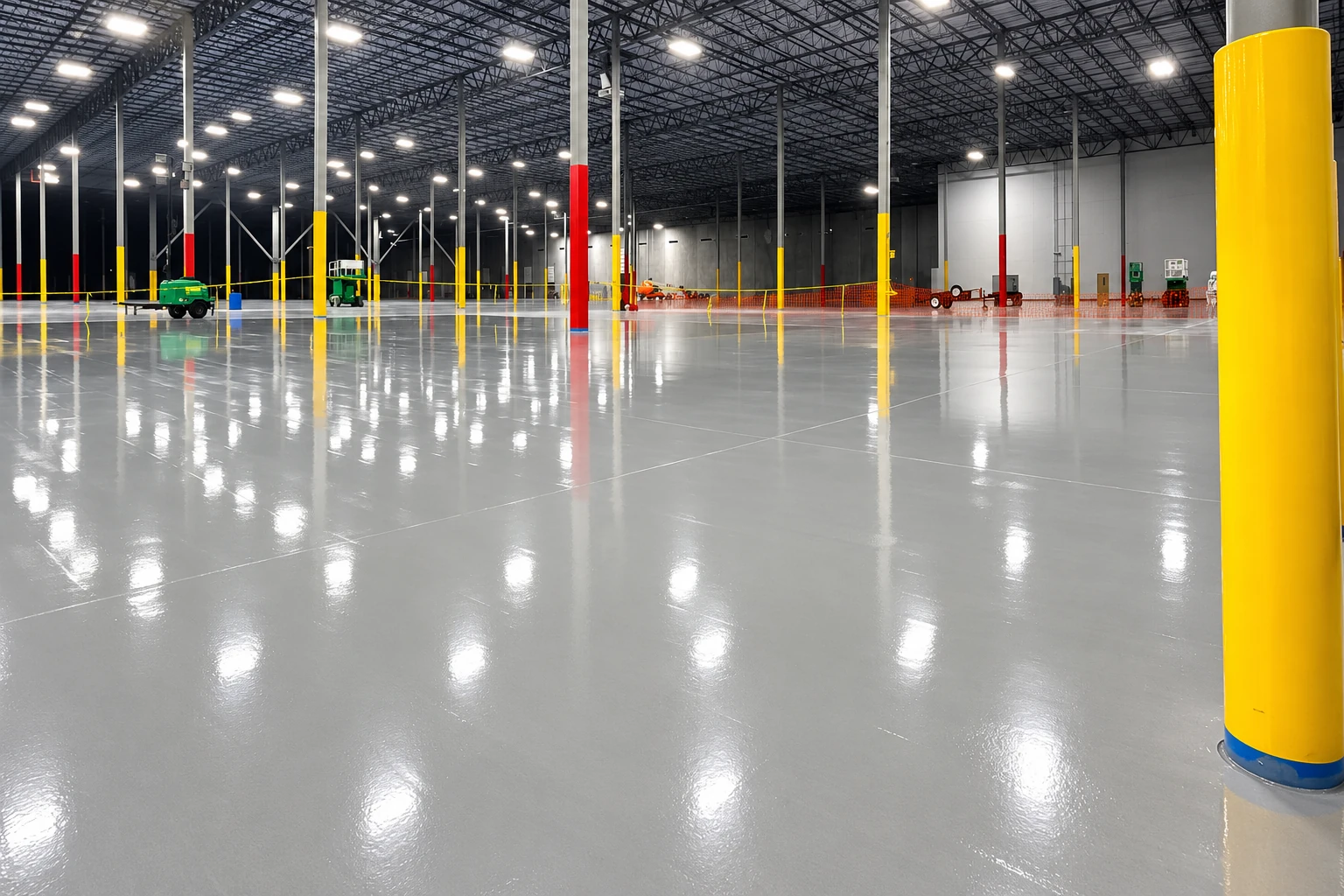
Commercial and industrial epoxy floor coatings in Spring Valley give a shop, warehouse or production floor a hard resin surface over prepared concrete, built to take chemicals, wear and daily traffic.
Shop and warehouse owners usually call us when bare concrete is dusting, staining or soaking up spills, or when an old coating has started peeling in the aisles. The price moves with the size of the floor, how much grinding and crack repair the slab needs and which system your chemicals, sun and traffic call for, while the schedule turns on the slab test, the cure and when you can spare the floor. You'll get your own number from the estimate I write on site.
We're known for taking our time on the slab before anything goes down, because nobody sees the prep once the floor is done, but it decides how the floor holds up.
I'd rather tell you plainly what your slab can handle than sell you a system that looks good for a season and then starts to lift.
I come out to look at every job and write the estimate, and our crew does the prep and coating, so the person who saw your floor is the one who planned the work.
Before I pick a system, I ask about the chemicals on your floor, how much sun it gets and where the forklifts run, and then we plan the work around how your business runs. Our crew grinds or shotblasts the concrete, roughing it up so the coating can grip, fixes cracks and low spots, and tests the slab before anything goes down. We mix and lay the epoxy base within the temperature limits the coating maker sets, because that base gives the floor its thickness and chemical resistance, and then we add the topcoat the job calls for. When we pack up, your building is left the way we found it, only with a better floor.
On heavy floors, a polyaspartic floor coating often goes on as the top layer, since it cures fairly fast and resists UV, stains and wear, but on industrial floors it works over an epoxy or urethane cement base rather than alone. If you've got a garage at home that needs the same kind of work, our garage floor coatings page covers that job.
Forklift tires and dropped pallets wear bare concrete fast, so these floors get a thicker epoxy build and a cure plan that keeps heavy traffic off until it's ready.
Oil, coolant and brake fluid soak into raw concrete and leave it slick and stained, so a sealed resin floor lets your crew wipe spills up instead of scrubbing them out.
Standard epoxy is fairly rigid, so cracks or heat movement in the slab can pass stress into it, and a flexible epoxy or hybrid system is the better pick there.
Customers walk these floors every day, so a smooth coating gives you a clean, even surface that mops up easily and doesn't hold dirt the way bare concrete does.
Send the form and we'll reply within one business day to set a time. I'll come out, look at the slab and write your estimate on site, free and with no obligation.
Tell us roughly how big the floor is and what happens on it now, so I come out with a fair idea of which system might fit.
List the chemicals that get stored or spilled, where the forklifts run and which areas get steady sun, because those decide the system we'll recommend.
Let us know when you're open and when the floor could sit empty, so we can plan the prep, the coating and the cure around your operations.
Examples of solid-color, flake and high-gloss resin finishes, plus layout ideas like marked aisles, to talk through at your estimate.
Straight answers to what business owners usually ask about downtime, coating choices, slab testing, permits and county rules.
Most commercial jobs take 2 to 5 days. A new coating usually takes light foot traffic after 24 hours, but forklifts and heavy equipment need 72 hours. Crews can often work nights or weekends, so the job and the forklift wait can fit around your operations. Warehouses of 10,000 square feet or more may take 1 to 2 weeks when done in phases.
A floor with strong acids or solvents usually needs a novolac epoxy, which resists many concentrated acids and solvents that standard epoxy can't, even when the floor is soaked. Steady sunlight can yellow or chalk standard epoxy, so a sunlit floor needs a UV-resistant grade or a sun-stable aliphatic topcoat written into the bid. Our work is backed by our satisfaction guarantee.
Yes, the slab gets a moisture test before any coating goes down. Too much moisture in concrete can make a coating lift off and break down, and coating makers generally require the test before installation. Newly poured concrete waits too, since one maker's instructions call for at least 28 days of curing first.
In unincorporated San Diego County, the county's Building Services Division issues building permits for residential and commercial structures. Some addresses here fall under a city instead, so before we start, we check with the office that covers your building. If they say a permit is needed, we'll walk you through it and take care of our part. We're fully licensed and insured.
Two county rules shape the job. The San Diego County Air Pollution Control District regulates coating work to control VOCs, the chemical vapors that help form ozone, so you can ask us how the products we pick fit its rules. The county also keeps runoff from cement work and anything but rainwater out of storm drains, so our dust and wash water stay on site.
Call (619) 648-8003 any day of the week until 9 PM, or send the form, and we'll set a time to look at your floor.